 Image 1 of 1
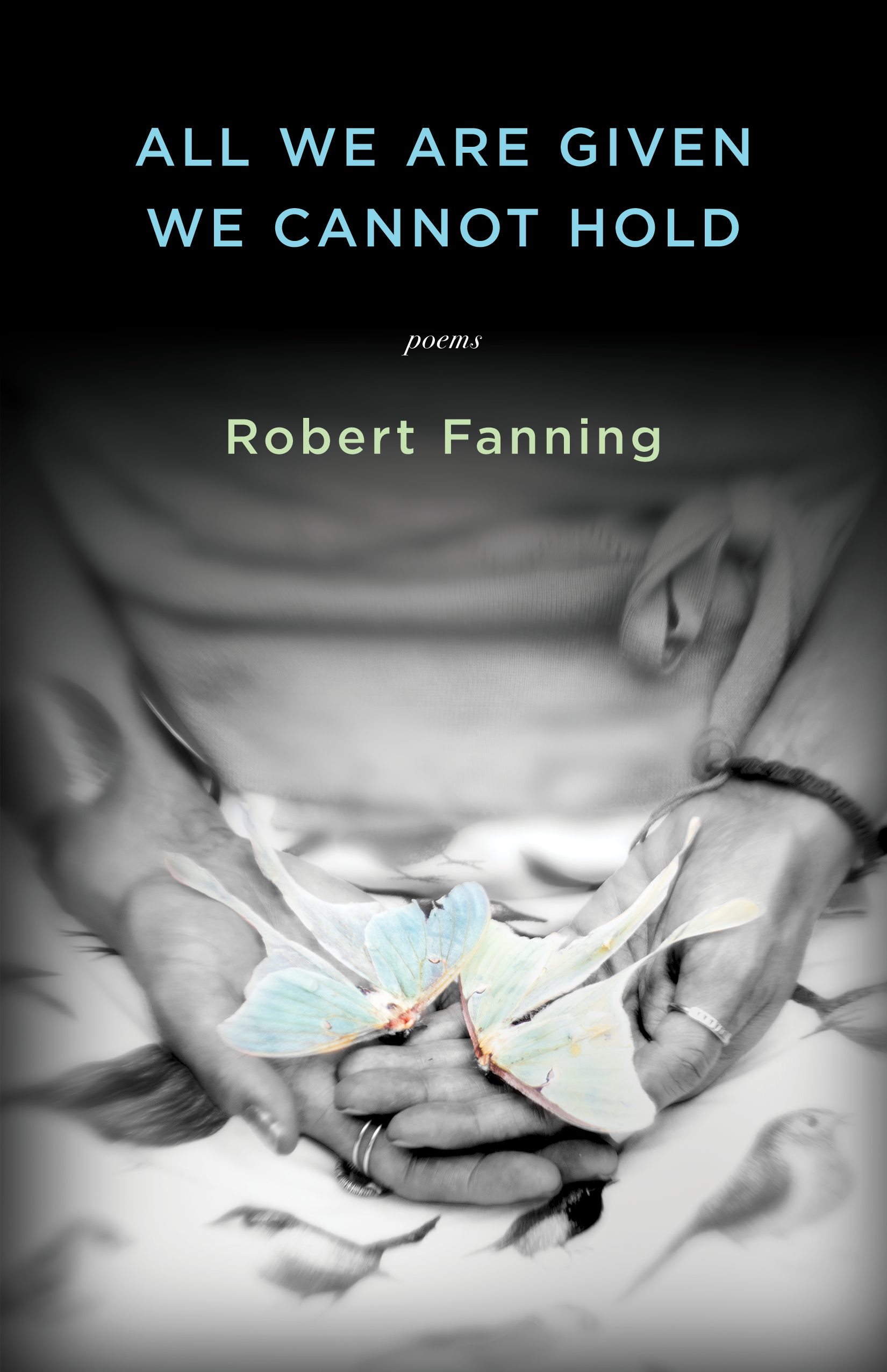
PRAISE FOR All We Are Given We Cannot Hold
“For the poet, no skill is more of service than observation—what is there, what once was and will be, where love left a mark. In this regard, Robert Fanning looks up to very few.”
—Foreword Reviews
"All We Are Given We Cannot Hold is a gorgeous work of gratitude and grief, full of odes and elegies written by one whose life’s work is, yes, the lyric but also love. These poems ache with tenderness and exactitude in equal measure; Robert Fanning’s sharp eye—for social and political dynamics, for complicated human nature, for the shadow and the seed—is matched by his gentle touch, the generosity with which he regards his flawed and flailing fellow travelers. Quite often, Fanning turns to portraiture, vivid and intimate renderings of his children, his wife, his mother, and makes clear how lucky he feels for the fleeting proximity that allows for such careful, affectionate seeing. Everything is slipping out of our hands, he tells us again and again, and how blessed we are by even the briefest chance to touch it. Stay with me, he intones, and though we all know—poet, readers—that nothing ever holds, we lean in and listen to “the chorus of bruise and roses” he offers. We stay as long as we can."
—Melissa Crowe, author of Lo and Dear Terror, Dear Splendor
“Robert Fanning’s All We Are Given We Cannot Hold is generous unto overflowing, with approaches to language that are at times visionary and towering, at others, intimate, tender, and elegiac, all during this ‘season of erasure’ and desolation, especially as he loses his extraordinary mother, ‘her belly,’ he writes of her, ‘my first sky.’ Fanning’s images are rich from his immersion in the natural world, images that evoke tenderness, but also violent beauty. Fanning’s awe is intense, as is his pain, which he conveys to the reader with urgency. For Fanning, the life force is what yearns. ‘There’s nothing as holy as want,’ he claims, in a poem whose energy is driven by the spiraling music of desire. He gives us that holiness most courageously in poems in which he explores ‘the forbidden world / that runs alongside the world,’ the yearning for touch and tenderness with other men, ‘our chests heaving with thrum and flutter, wet / with sky.’ These poems get at both the source and antidote to loneliness, to an unlocking of the soul that the rare lyric poem can articulate and forge.”
—Diane Seuss, author of frank: sonnets and Modern Poetry
"There is so much to praise about this book, Fanning’s fifth, so where to begin such singing? There is the music of Fanning’s ear, of course, which readers of Fanning’s work have come to expect: a musicality shaped by the fathering influence of Dylan Thomas and Theodore Roethke. There is the exactness behind Fanning’s song, the particulars of things seen and heard and made luminous with meaning. But there’s another something more that calls our attention to it, that other kind of something that can’t be simply seen, a something that can only be felt and experienced and transferred through the language of singing itself. That is Fanning’s gift among all the other expected tangibles: Fanning forces us to feel even when we might not want to go into the there of such heightened feeling. And where, exactly, is there? The interior of a man whose heart is fully alive and unflinchingly unafraid of being in the world. All of which is to say this: that every Robert Fanning poem is a deep dive into the human heart. I had to put this book down and out of eye-shot too many times to count. The losses here run deep, both the private and public. But it’s what the poet calls “the love between us” that saves us and teaches us how to live. There is no other way to say it: I was heart-ravaged by this book. Ready for your own heart to be ripped apart. Fanning’s own heart leads the way into piecing it and us, his readers, back together."
—Peter Markus, author of When Our Fathers Return to Us as Birds
"In All We Are Given We Cannot Hold Robert Fanning affirms the title’s inescapable paradox of the surprise of wonder and joy amid the ubiquity of emotional pain. Fanning, a poet of empathic phenomenology, embodies and reveals what is all but impossible to articulate: reality’s multiplicity. In doing so, he shows us that time—past, present, and future— are always now. And every day we live surrounded by secrets until . . . In the poem 'Driver’s Education' his multi-layered inner world sighs that we are 'wounded by what was meant to keep us safe.' In his resigned and comforting voice Fanning, whether focused on a viral video, death bed, or bottle spun for a kiss in the basement after school, affirms the constancy of love while threats lurk—but where?"
—Jack Ridl, author of All At Once and Practicing to Walk Like a Heron
"In Robert Fanning’s All We Are Given We Cannot Hold, he takes on the familiar world where one goes to driver’s ed, out to eat at restaurants, watches Shark Week. But what does the daily become when faced with a mother’s dying, a child’s pain? Because the act of a poem can undo the ordinary to reveal, Fanning recreates the dissociative leaps of grief and going forward, flipping the familiar into the unfamiliar, as the world becomes when faced with loss. But one must go on ahead bravely amid the daily beauty and strange music that can heal, even if it seems unsayable, underneath this language there is a light, as if ‘a fold of silence where words once were, the way a veil of clouds reveals the momentary stars.’”
—Sean Thomas Dougherty, author of Death Prefers the Minor Keys
“Robert Fanning’s poems have an uncanny ability to sing their way into your heart, then break it wide open. This transcendent collection is a culmination of that power — flush with hymns of ache, outrage and awe for a world that is 'always falling away.' From anxious adolescent fumblings to a monarch stirring in its chrysalis, and through wrenching explorations of grief, this book offers a sweeping, Whitmanesque embrace of as much of life as can be gathered into a few densely wrought lines. Fanning does it all with exceptional tenderness, while showcasing a deft mastery of music, language and form. Again and again, he reminds us that 'Nothing this astonishing ever holds.' But when you read these poems, it will.”
—Christina Kallery, author of Adult Night at Skate World
ABOUT THE AUTHOR
Robert Fanning is the author of four full-length poetry collections, Severance, Our Sudden Museum, American Prophet and The Seed Thieves, as well as three chapbooks: Prince of the Air, Sheet Music and Old Bright Wheel. His poems have appeared in Poetry, Ploughshares, Shenandoah, Gulf Coast, The Common, Waxwing, Diode, and many other journals. He is a Professor at Central Michigan University and the Founder/Facilitator of the Wellspring Literary Series in Mt. Pleasant, MI.